China Exports First Homegrown F-class Heavy Duty Gas Turbine for Global Power Generation Projects
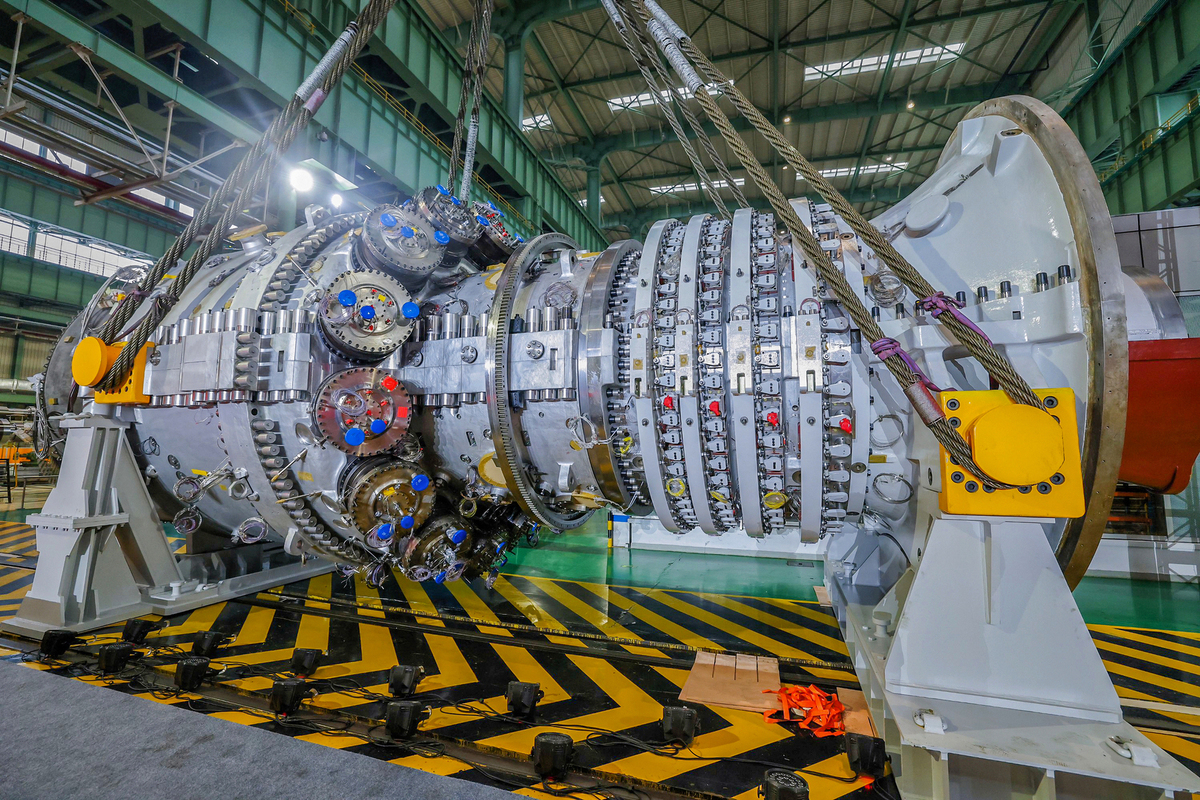
The inaugural overseas shipment of the domestically developed 50 MW G50 F-class heavy-duty gas turbine from Sichuan to Kazakhstan marks a pivotal transition for the global power generation equipment supply chain. Historically, the high-capacity industrial gas turbine sector has been heavily concentrated, with three to four multinational OEM engineering vendors controlling nearly 80 percent of the worldwide market share. Moving a indigenous 50-megawatt unit into international commercial deployment demonstrates that alternative manufacturing ecosystems have achieved the engineering rigor, thermal efficiency, and manufacturing repeatability required by global grid operators. For Kazakhstan's power grid, integrating three G50 units will add 150 megawatts of fast-ramping baseload capacity, a critical upgrade for regional power grids working to balance intermittent renewable energy inputs while maintaining frequency stability within a peak variance of less than 0.5 hertz.
From a mechanical engineering perspective, manufacturing an F-class gas turbine represents one of the highest barriers to entry in industrial turbomachinery. Operating at firing temperatures approaching 1,400 degrees Celsius and rotational speeds around 3,000 to 3,600 revolutions per minute, these systems demand advanced single-crystal superalloy casting, specialized thermal barrier coatings, and complex internal air-cooling channel geometries to prevent structural creep and thermal fatigue. Developing such platforms requires integrating technical expertise across more than 100 distinct scientific fields, ranging from computational fluid dynamics to advanced metallurgy. Expanding domestic capabilities from 50-megawatt class turbines to heavy-duty 300 MW and 550 MW architecture demonstrates a broad maturation across the manufacturing supply chain, achieving the precision machining tolerances down to the single-digit micrometer scale necessary for long-life rotor assemblies.
The expansion of Chinese power equipment manufacturers into foreign markets aligns directly with a sharper spike in global electricity consumption, where annual power demand growth in major industrial sectors is projected to climb above 3.5 to 4.0 percent through the decade. A major driver behind this surge is the rapid infrastructure rollout of artificial intelligence data centers, where single hyper-scale facilities routinely demand continuous power loads between 100 MW and 500 MW with 99.999 percent uptime reliability. Modern F-class gas turbines, operating in combined-cycle gas turbine configurations, can achieve thermal conversion efficiencies exceeding 58 to 60 percent while offering low-emissions profile flexibility. This makes natural gas turbines an essential transitional energy source for meeting immediate data center capacity expansion, bridging the gap while zero-carbon baseload solutions like advanced nuclear or large-scale energy storage complete long-term capital deployment cycles.
Mitigating operational risk in cross-border turbomachinery deployments hinges heavily on life-cycle service support and localized system engineering. Environmental conditions in Central Asia present severe operational parameters, including ambient temperature swings spanning from minus 35 degrees Celsius in winter to over 40 degrees Celsius in summer, along with high atmospheric dust particulate densities. Customizing critical subsystems, particularly multi-stage air intake filtration assemblies and rotor blade surface treatments, directly protects compressor aerodynamics and maintains steady-state volumetric air flow rates exceeding hundreds of kilograms per second. Comprehensive long-term service agreements covering monitoring, predictive maintenance, and localized spare parts inventory are essential for maintaining unit availability rates above 95 percent across a planned 30-year operational life cycle.
Ultimately, long-term market adoption will depend on cost efficiency, execution timelines, and lifecycle levelized cost of electricity metrics. Standard manufacturing and commissioning timelines for heavy industrial turbines traditionally range from 24 to 36 months, but streamlined supply chains can compress factory lead times by 15 to 20 percent. With global capital expenditure budgets for power infrastructure facing inflationary pressure, competitive unit equipment costs per kilowatt, combined with reliable delivery schedules, offer power developers a clear value proposition. As highlighted in coverage by People's Daily, the expansion of high-end energy equipment exports reflects a broader restructuring of international industrial cooperation, where domestic engineering capability, cost competitiveness, and robust manufacturing throughput combine to reshape the global energy hardware landscape.
News source: https://peoplesdaily.pdnews.cn/china/er/30053037620